Knowledge Base : Tutorials : Battery Articles : Battery Basics: A Layman's Guide to Batteries

Battery Basics: A Layman's Guide to Batteries

Battery Basics Tutorial

If you have done any research on how batteries work or what you should look for when selecting a battery, you are probably buried in information, some of which is conflicting. At BatteryStuff, we aim to clear that up a bit.You have most likely heard the term K.I.S.S. (Keep It Simple, Stupid). I am going to attempt to explain how lead acid batteries work and what they need without burying you with a bunch of needless technical data. I have found that battery data will vary somewhat from manufacturer to manufacturer, so I will do my best to boil that data down. This means I may generalize a bit, while staying true to purpose.

The commercial use of the lead acid battery is over 100 years old. The same chemical principal that is being used to store energy is basicly the same as our Great Grandparents may have used.

If you can grasp the basics you will have fewer battery problems and will gain greater battery performance, reliability, and longevity. I suggest you read the entire tutorial, however I have indexed all the information for a quick read and easy reference.

A battery is like a piggy bank. If you keep taking out and putting nothing back you soon will have nothing. Present day chassis battery power requirements are huge. Consider today’s vehicle and all the electrical devices that must be supplied. All these electronics require a source of reliable power, and poor battery condition can cause expensive electronic component failure. Did you know that the average auto has 11 pounds of wire in the electrical system? Look at RVs and boats with all the electrical gadgets that require power. It was not long ago when trailers or motor homes had only a single 12-volt house battery. Today it is standard to have two or more house batteries powering inverters up to 4000 watts.

Average battery life has become shorter as energy requirements have increased. Life span depends on usage; 6 months to 48 months, yet only 30% of all batteries actually reach the 48-month mark.

A Few Basics

Battery HydrometerThe Lead Acid battery is made up of plates, lead, and lead oxide (various other elements are used to change density, hardness, porosity, etc.) with a 35% sulfuric acid and 65% water solution. This solution is called electrolyte, which causes a chemical reaction that produce electrons. When you test a battery with a hydrometer, you are measuring the amount of sulfuric acid in the electrolyte. If your reading is low, that means the chemistry that makes electrons is lacking. So where did the sulfur go? It is resting on the battery plates and when you recharge the battery, the sulfur returns to the electrolyte.

  1. Safety
  2. Battery types, Deep Cycle and Starting
  3. Wet Cell, Gel-Cell and Absorbed Glass Mat (AGM)
  4. CCA, CA, AH and RC; what's that all about?
  5. Battery Maintenance
  6. Battery Testing
  7. Selecting and Buying a New Battery
  8. Battery Life and Performance
  9. Battery Charging
  10. Battery Do's
  11. Battery Don'ts


1. We must think safety when we are working around and with batteries. Remove all jewelry. After all you don't want to melt your watchband while you are wearing the watch. The hydrogen gas that batteries make when charging is very explosive. We have seen several instances of batteries blowing up and drenching everything in sulfuric acid. That is no fun, and would have been a good time to use those safety goggles that are hanging on the wall. Heck, just break out your disco outfit. Polyester is not affected by Sulfuric Acid, but anything with cotton will be eaten up. If you do not feel the need to make a fashion statement just wear junk clothes, after all Polyester is still out of style. When doing electrical work on vehicles it is best to disconnect the ground cable. Just remember you are messing with corrosive acid, explosive gases and 100's amps of electrical current.

2. Basically there are two types of lead acid batteries (along with 3 sub categories); The two main types are Starting (cranking), and Deep Cycle (marine/golf cart). The starting battery (SLI starting lights ignition) is designed to deliver quick bursts of energy (such as starting engines) and therefore has a greater plate count. The plates are thinner and have somewhat different material composition. The deep cycle battery has less instant energy, but greater long-term energy delivery. Deep cycle batteries have thicker plates and can survive a number of discharge cycles. Starting batteries should not be used for deep cycle applications because the thinner plates are more prone to warping and pitting when discharged. The so-called Dual Purpose Battery is a compromise between the two types of batteries, though it is better to be more specific if possible.

3. Wet Cell (flooded), Gel Cell, and Absorbed Glass Mat (AGM) are various versions of the lead acid battery. The Wet cell comes in two styles; Serviceable and Maintenance free. Both are filled with electrolyte and are basicly the same. I prefer one that I can add water to and check the specific gravity of the electrolyte with a hydrometer. The Gel Cell and the AGM batteries are specialty batteries that typically cost twice as much as a premium wet cell. However they store very well and do not tend to sulfate or degrade as easily as wet cell. There is little chance of a hydrogen gas explosion or corrosion when using these batteries; these are the safest lead acid batteries you can use. Gel Cell and some AGM batteries may require a special charging rate. If you want the best,most versatile type, consideration should be given to the AGM battery for applications such as Marine, RV, Solar, Audio, Power Sports and Stand-By Power just to name a few. If you don't use or operate your equipment daily, AGM batteries will hold their charge better that other types. If you must depend on top-notch battery performance, spend the extra money. Gel Cell batteries still are being sold but AGM batteries are replacing them in most applications. There is a some common confusion regarding AGM batteries because different manufactures call them by different names; some of the more common names are "sealed regulated valve", "dry cell", "non spillable", and "Valve Regulated Lead Acid" batteries. In most cases AGM batteries will give greater life span and greater cycle life than a wet cell battery.
SPECIAL NOTE about Gel Batteries: It is very common for individuals to use the term GEL CELL when referring to sealed, maintenance free batteries, much like one would use Kleenex when referring to facial tissue or "Xerox machine" when referring to a copy machine. Be very careful when specifying a battery charger, many times we are told by customer they are requiring a charger for a Gel Cell battery and in fact the battery is not a Gel Cell.

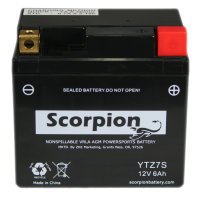
Scorpion BatteryAGM: The Absorbed Glass Matt construction allows the electrolyte to be suspended in close proximity with the plates active material. In theory, this enhances both the discharge and recharge efficiency. Common manufacturer applications include high performance engine starting, power sports, deep cycle, solar and storage battery. The larger AGM batteries we sell are typically good deep cycle batteries and they deliver their best life performance if recharged before allowed to drop below the 50% discharge rate. The Scorpion motorcycle batteries we carry are a nice upgrade from your stock flooded battery, and the Odyssey branded batteries are fantastic for holding their static charge over long periods of non use. When Deep Cycle AGM batteries are discharged to a rate of no less than 60% the cycle life will be 300 plus cycles.

GEL: The Gel Cell is similar to the AGM style because the electrolyte is suspended, but different because technically the AGM battery is still considered to be a wet cell. The electrolyte in a Gel Cell has a silica additive that causes it to set up or stiffen. The recharge voltage on this type of cell is lower than the other styles of lead acid battery. This is probably the most sensitive cell in terms of adverse reactions to over-voltage charging. Gel Batteries are best used in VERY DEEP cycle application and may last a bit longer in hot weather applications. If the incorrect battery charger is used on a Gel Cell battery poor performance and premature failure is certain.

4. CCA, CA, AH and RC. What are these all about? These are the standards that most battery companies use to rate the output and capacity of a battery.

Cold cranking amps (CCA) is a measurement of the number of amps a battery can deliver at 0 ° F for 30 seconds and not drop below 7.2 volts. So a high CCA battery rating is especially important in starting battery applications, and in cold weather.This measurement is not particularly important in Deep cycle batteries, though it is the most commonly 'known' battery measurement.

CA is cranking amps measured at 32 degrees F. This rating is also called marine cranking amps (MCA). Hot cranking amps (HCA) is seldom used any longer but is measured at 80 ° F.

Reserve Capacity (RC) is a very important rating. This is the number of minutes a fully charged battery at 80 ° F will discharge 25 amps until the battery drops below 10.5 volts.

An amp hour (AH) is a rating usually found on deep cycle batteries. The standard rating is an Amp rating taken for 20 Hours. What this means, say for a 100 AH rated battery is this: Draw from the battery for 20 hours and it will provide a total of 100 amps. That translates to about 5 amps an hour. 5 x 20 = 100. However, it's very important to know that the total time of discharge and load applied is not a linear relationship. As your load increases, your realized capacity decreases. This means if you discharged that same 100 AH battery by a 100 amp load, it will not give you one hour of runtime. On the contrary, the perceived capacity of the battery will be that of 64 Amp Hours.

5.Battery Maintenance is an important issue. The battery should be cleaned using a baking soda and water solution; a couple of table spoons to a pint of water. Cable connections need to be cleaned and tightened as battery problems are often caused by dirty and loose connections. A serviceable battery needs to have the fluid level checked. Use only mineral free water, Distilled is best as all impurities have been removed, and there is nothing left that could contaminate your cells. Don't overfill battery cells especially in warmer weather because the natural fluid expansion in hot weather can push excess electrolytes from the battery. To prevent corrosion of cables on top post batteries use a small bead of silicone sealer at the base of the post and place a felt battery washer over it. Coat the washer with high temperature grease or petroleum jelly (Vaseline), then place cable on the post and tighten. Coat the exposed cable end with the grease. Most folks don't know that just the gases from the battery condensing on metal parts cause most corrosion.

6.Digital Multi-MeterBattery Testing can be done in more than one way. The most accurate method is measurement of specific gravity and battery voltage. To measure specific gravity buy a temperature compensating hydrometer, to measure voltage use a digital D.C. Voltmeter. A quality load tester may be a good purchase if you need to test sealed batteries.

For any of these methods, you must first fully charge the battery and then remove the surface charge. If the battery has been sitting at least several hours (I prefer at least 12 hours) you may begin testing. To remove surface charge the battery must be discharged for several minutes. Using a headlight (high beam) will do the trick. After turning off the light you are ready to test the battery.

State of ChargeSpecific GravityVoltage
    12V 6V
100% 1.265 12.7 6.3
75% 1.225 12.4 6.2
50% 1.190 12.2 6.1
25% 1.155 12.0 6.0
Discharged 1.120 11.9 6.0


Load testing is yet another way of testing a battery. Load test removes amps from a battery much like starting an engine would. A load tester can be purchased at most auto parts stores. Some battery companies label their battery with the amp load for testing. This number is usually 1/2 of the CCA rating. For instance, a 500CCA battery would load test at 250 amps for 15 seconds. A load test can only be performed if the battery is near or at full charge.

The results of your testing should be as follows:

Hydrometer readings should not vary more than .05 differences between cells.

Digital Voltmeters should read as the voltage is shown in this document. The sealed AGM and Gel-Cell battery voltage (full charged) will be slightly higher in the 12.8 to 12.9 ranges. If you have voltage readings in the 10.5 volts range on a charged battery, that typically indicates a shorted cell.

If you have a maintenance free wet cell, the only ways to test are voltmeter and load test. Any of the maintenance free type batteries that have a built in hydrometer(black/green window) will tell you the condition of 1 cell of 6. You may get a good reading from 1 cell but have a problem with other cells in the battery.

When in doubt about battery testing, call the battery manufacturer. Many batteries sold today have a toll free number to call for help.

7. Selecting a Battery - When buying a new battery I suggest you purchase a battery with the greatest reserve capacity or amp hour rating possible. Of course the physical size, cable hook up, and terminal type must be a consideration. You may want to consider a Gel Cell or an Absorbed Glass Mat (AGM) rather than a Wet Cell if the application is in a harsher environment or the battery is not going to receive regular maintenance and charging.

Be sure to purchase the correct type of battery for the job it must do. Remember that engine starting batteries and deep cycle batteries are different. Freshness of a new battery is very important. The longer a battery sits and is not re-charged the more damaging sulfation build up there may be on the plates. Most batteries have a date of manufacture code on them. The month is indicated by a letter 'A' being January and a number '4' being 2004. C4 would tell us the battery was manufactured in March 2004. Remember the fresher the better. The letter "i" is not used because it can be confused with #1.

Battery warranties are figured in the favor of battery manufactures. Let's say you buy a 60-month warranty battery and it lives 41 months. The warranty is pro-rated so when taking the months used against the full retail price of the battery you end up paying about the same money as if you purchased the battery at the sale price. This makes the manufacturer happy. What makes me happy is to exceed the warranty. Let me assure you it can be done.

8. Battery life and performance - Average battery life has become shorter as energy requirements have increased. Two phrases I hear most often are "my battery won't take a charge, and my battery won't hold a charge". Only 30% of batteries sold today reach the 48-month mark. In fact 80% of all battery failure is related to sulfation build-up. This build up occurs when the sulfur molecules in the electrolyte (battery acid) become so deeply discharged that they begin to coat the battery's lead plates. Before long the plates become so coated that the battery dies. The causes of sulfation are numerous. Let me list some for you.

  • Batteries sit too long between charges. As little as 24 hours in hot weather and several days in cooler weather.
  • Battery is stored without some type of energy input.
  • "Deep cycling" an engine starting battery. Remember these batteries can't stand deep discharge.
  • Undercharging of a battery to only 90% of capacity will allow sulfation of the battery using the 10% of battery chemistry not reactivated by the incompleted charging cycle.
  • Heat of 100 plus F., increases internal discharge. As temperatures increase so does internal discharge. A new fully charged battery left sitting 24 hours a day at 110 degrees F for 30 days would most likely not start an engine.
  • Low electrolyte level - battery plates exposed to air will immediately sulfate.
  • Incorrect charging levels and settings. Most cheap battery chargers can do more harm than good. See the section on battery charging.
  • Cold weather is also hard on the battery. The chemistry does not make the same amount of energy as a warm battery. A deeply discharged battery can freeze solid in sub zero weather.
  • Parasitic drain is a load put on a battery with the key off. More info on parasitic drain will follow in this document.


There are ways to greatly increase battery life and performance. All the products we sell are targeted to improve performance and battery life.

Battery EqualizerAn example: Let's say you have "toys"; an ATV, classic car, antique car, boat, Harley, etc. You most likely don't use these toys 365 days a year as you do your car. Many of these toys are seasonal so they are stored. What happens to the batteries? Most batteries that supply energy to power our toys only last 2 seasons. You must keep these batteries from sulfating or buy new ones. We sell products to prevent and reverse sulfation. The PulseTech products are patented electronic devices that reverse and prevent sulfation. Also Battery Equaliser, a chemical battery additive, has proven itself very effective in improving battery life and performance. Other devices such as Solar Trickle Chargers are a great option for battery maintenance.

Parasitic drain is a load put on a battery with the key off. Most vehicles have clocks, engine management computers, alarm systems, etc. In the case of a boat you may have an automatic bilge pump, radio, GPS, etc. These devices may all be operating without the engine running. You may have parasitic loads caused by a short in the electrical system. If you are always having dead battery problems most likely the parasitic drain is excessive. The constant low or dead battery caused by excessive parasitic energy drain will dramatically shorten battery life. If this is a problem you are having, check out the Priority Start and Marine Priority Start to prevent dead batteries before they happen. This special computer switch will turn off your engine start battery before all the starting energy is drained. This technology will prevent you from deep cycling your starting battery.

9.Battery Tender Plus Battery Charging - Remember you must put back the energy you use immediately. If you don't the battery sulfates and that affects performance and longevity. The alternator is a battery charger. It works well if the battery is not deeply discharged. The alternator tends to overcharge batteries that are very low and the overcharge can damage batteries. In fact an engine starting battery on average has only about 10 deep cycles available when recharged by an alternator. Batteries like to be charged in a certain way, especially when they have been deeply discharged. This type of charging is called 3 step regulated charging. Please note that only special SMART CHARGERS using computer technology can perform 3 step charging techniques. You don't find these types of chargers in parts stores and Wal-Marts. The first step is bulk charging where up to 80% of the battery energy capacity is replaced by the charger at the maximum voltage and current amp rating of the charger. When the battery voltage reaches 14.4 volts this begins the absorption charge step. This is where the voltage is held at a constant 14.4 volts and the current (amps) declines until the battery is 98% charged. Next comes the Float Step. This is a regulated voltage of not more than 13.4 volts and usually less than 1 amp of current. This in time will bring the battery to 100% charged or close to it. The float charge will not boil or heat batteries but will maintain the batteries at 100% readiness and prevent cycling during long term inactivity. Some Gel Cell and AGM batteries may require special settings or chargers.

10. Battery Do's

  • Think Safety First.
  • Do read entire tutorial
  • Do regular inspection and maintenance especially in hot weather.
  • Do recharge batteries immediately after discharge.
  • Do buy the highest RC reserve capacity or AH amp hour battery that will fit your configuration.


11. Battery Don'ts

  • Don't forget safety first.
  • Don't add new electrolyte (acid).
  • Don't use unregulated high output battery chargers to charge batteries.
  • Don't place your equipment and toys into storage without some type of device to keep the battery charged.
  • Don't disconnect battery cables while the engine is running (your battery acts as a filter).
  • Don't put off recharging batteries.
  • Don't add tap water as it may contain minerals that will contaminate the electrolyte.
  • Don't discharge a battery any deeper than you possibly have to.
  • Don't let a battery get hot to the touch and boil violently when charging.
  • Don't mix size and types of batteries.


There are many points and details I have not written about because I wanted to keep this as short and simple as possible. Further information can be found at the links below. If you are aware of sites with good battery maintenance information please let me know.

Additional Battery Tutorial http://www.batteryfaq.org


95 Responses,   4.8 Rating

Subscribe to comments with RSS.

  • What is the connection to the battery tocharge a 24volt system

    Jimmy
    January 22, 2012 a 8:06 am
    • If you have 2 batteries in series, the voltage increases. The most common form of 24 volt systems involves two 12 volt batteries connected together, a wire from the positive terminal of one battery to the negative on the other. For more information about constructing battery banks, read this helpful article.

      http://www.batterystuff.com/kb/articles/battery-articles/battery-bank-tutorial.html

      If you have a 24 volt charger, you must treat your two 12 volt batteries as if they were a single battery. The open terminals on both ends would be the required positive and negative access points.

      James
      January 23, 2012 a 8:50 am
    • This is just what I need to give me confidence in dealing with a battery issue. Much appreciated.

      Desmond
      January 18, 2012 a 2:04 pm
      • Just to let you know that your battery basics piece was well written and useful. I appreciate your hard work and your passion for your subject.

        Keith Clemens
        January 23, 2012 a 7:38 am
        • Over the last 40 years I have puchased endless numbers of leisure batteries for my caravans none have ever lasted more than 12 mounths althouth I have charged them regularly.My latest one has just failed after 6 mounths and the manufacturers stamp 15 indicates January 2005 surerly this must be one of the reasons they do not last the coarse.I have found out more about batteries since reading Battery Stuff.Com although I am a retired motor engineer,Well Done.

          John Hackney
          January 26, 2012 a 11:03 am
          • hi this is a common problem, many battery manufacturers make batteries that they claim are leisure batteries. the advice i will give is that you should buy a battery with the largest amps as possible that will fit in the space that you have, in my opinion you should buy an AGM battery as this will discharge and recover better after use, they are more expensive but should last much longer. thanks eric roberts www.batteriesontheweb.co.uk

            Eric Roberts
            March 7, 2012 a 11:41 pm
          • Is it possible to have 12 volts from a battery and low or weak cca ? Also tell me if im thinking wrong , but I have theory , that a battery is allot like your arm , you arm has the 12 volts and the muscles in your arm potentially are your amps , you can with stand holding weight for a certain amount of time until you become weak and need to relax for a few moments before you can “crank” again , would you say that would be a good example if i were to try and explain how a battery functions to people who don‘t speak english ?

            Larry
            January 27, 2012 a 7:15 am
            • That is a good example, yes. Some arms have less muscle mass and others have more. But all the same number of muscles in the arm. 12 volt batteries all have 6 cells. Each cell is 2 volts. 2 × 6 = 12. But the cells have plates inside of them. The more plates, the more current can run through, thus more CCA. Large and small batteries all have 6 cells, but the size and number of plates can vary greatly. I hope this helps.

              James
              January 27, 2012 a 9:23 am
            • if i could rate your article out of ten, i would give it ten.
              very informative alas i did not solve my problem
              what is the method of getting a rechargable battery to hold charge,
              will short overcharging periods do the trick?

              John
              January 30, 2012 a 9:31 pm
              • If you‘re referring to a rechargeable lead acid battery, then there could be many reasons why a battery does not “hold a charge”. There could be a parasitic drain. There could be a short or open cell. There could be an internal defect such as a weak weld. Or the battery could simply be deeply discharged, and if you‘re using a smart charger, find that the charger simply will not charge the dead battery. This is primarily due to the low voltage safety disconnect found in most microprocessor controlled chargers.

                James
                January 31, 2012 a 7:44 am
              • Very important article on rechargeable batteries.

                We are planning to install Lead Gel batteries in our AS/RS equipments. Shall we go for Lead Gel or AGM type of batteries ? Why ? Give us advantages in terms of cost & safety while selecting the type of battery.
                Pls help us to decide.
                thanks

                JAYANTI
                February 2, 2012 a 3:31 am
                • Hello,

                  Gel and AGM batteries are both nice because of the maintenance free nature and sealed case. The Gels are able to deep discharge better (well, with less negative effects than the AGM). However, the Gel battery requires a compatible charger/regulator. Normal wet cels and AGM batteries effectively charge at 14.6 volts or higher. But the Gel battery should be no more than 14.2 volts. It really does make a difference. They are more fragile and can be damaged easier when charging.

                  For more information, please read GEL Vs. AGM.
                  http://www.batterystuff.com/kb/battery-articles/gel-vs-agm.html

                  James Ville
                  February 2, 2012 a 8:31 am
                • Hi, I have an older 4 ×4 truck with no electronics. However, I have an inverter to power (mainly laptops, gadgets), two external lights but no winch. My current alternator is rated at 75amps and my current battery at 80ams / CCA 780 / CR 120. I want to install a split batteyr system (solenoid+monitor) along with another batter (same power or slightly higher). Do I need to upgrade my alternator.. say to a 100 amps? Can a 75amp alternator comfortably charge both batteries..given than I\‘m using a \“smart\” split battery charging system? or am I asking for trouble….ie: a dead alternator? Thanks

                  Bert
                  February 4, 2012 a 5:19 pm
                  • You would be best off going with the larger alternator. 75 amps may be enough, but upgrading to the 100 amp system would make sense.

                    Jeremy
                    February 6, 2012 a 2:40 pm
                  • Two weeks ago I purchased a new car Buick Enclave that had been on the lot for an extended period of time. Everything seemed to be fine until I took a long trip (10hrs). The next morning I used the remote start to warm up the car then turned it off and continued to load the car using the remote hatch lift several times. About ten minutes later I got in the car and didn‘t have enough battery to start it. I was able to get a boost to start the engine and return home (10hrs). I took the car to the dealer the next morning to have it checked out and was told the battery was good as it checked out at 12.3 volts. Doesn‘t that show a discharged battery? Should the charging system maintain the battery at 12.6 to 12.8 volts? The next step is to have the electrical output checked. I would appreciate your input as to what I should have them check next. Thanks

                    Bob G
                    February 9, 2012 a 2:20 pm
                    • Hello Bob,

                      You are correct. The battery should be reading more than 12.3 volts. If the battery cannot reach over 12.6 volts, then there is likely a sulfation problem. the more sulfation on the plates, the less surface area. in turn, that results to less power and pre-mature failure.

                      James Ville
                      February 9, 2012 a 2:50 pm
                    • hi I am extremely interested in the subject and would like to thank you for clearing up a few things that i had previously not known.

                      Denise Keilholtz
                      February 14, 2012 a 4:31 pm
                      • hey, i am trying to charge 2 deepcycles in parallel with a 6 amp charger (12v) is this any diffrent than charging a single?

                        Kris F
                        February 16, 2012 a 1:10 am
                        • When you charge 2 deep cycle batteries in parallel, you’ve essentially doubled your capacity. The charger will recognize your battery bank as a single battery. If your 6 amp charger took 4 hours to charge one battery, it will now take 8 to charge both. The resistance has increased with the increase in capacity, so it will take longer to charge. As for the connections, you can hook your charger to the positive and negative terminal from one battery or both. For a 2 battery system, it doesn’t make a difference.

                          James
                          February 16, 2012 a 8:32 am
                          • “The resistance has increased with the increase in capacity,” Not so, resistances in parallel decrease. It takes longer to charge because you are charging two batteries at the same time instead of one.

                            Paul
                            April 15, 2012 a 8:49 am
                            • Resistance is based on the internal battery chemistry. It‘s not constant, but it relates to the strength of the charge rate versus the state of charge in the batteries. Two batteries in parallel will indeed lower the resistance. The charge time may not be quicker, but it will be more efficient.

                              Tech
                              April 16, 2012 a 11:03 am
                        • I have a few questions about sulfation removal.

                          1. How can a person determine how much sulfation has occurred inside a battery?
                          2. Which de-sulfation device do you most highly recommend to remove sulfation from battery plates?
                          3. How much time is required to fully de-desulfate a battery? If the de-sulfation device isn‘t capable of fully de-sulfating a battery, can you let me know how much de-sulfation such a device can provide.

                          Thx, Z

                          Z
                          February 17, 2012 a 4:37 am
                          • 1)There is no exact way to determine the amount of sulfation, but a hydrometer is helpful. By telling the specific gravity, you can determine the strength of the electrolyte. Typically, the more sulfation on the plates, the weaker the strength of electrolyte. If you have sealed batteries, a hydrometer will not work.
                            2)If you have a flooded battery, I recommend using Battery Equalizer in conjunction with a pulsing charging, such as Battery MINDer or PulseTech. Exact model will depend on the capacity of your battery.
                            3)You’ll see the most dramatic results after about 2 weeks of continuous pulsing. The harder, crystallized sulfate which took a long time to build up may take an additional 2 months before reaching a another restore point. On average, a de-sulfated battery may be restored up to 80% of its original factory capacity.

                            James
                            February 17, 2012 a 9:58 am
                          • I am purchasing a 125 watt solar panel and want to purchase two 12 volt RV batteries.I dry camp alot and want to be able to maximize my reserve capacity using the solar charging to replenish the drain on the batteries. My question is what size battery re the 20 hr amp rating would you recommend using two twelves and AGM or Gel? I do not winter camp so majority of use is April to Oct. Apprecite your expertise.

                            Thanks TP

                            Todd
                            February 22, 2012 a 6:21 pm
                            • If want to size the batteries, you will need to know your load amount. If you have this, please use our Sizing a 12 Volt Battery to a Load Calculator found here:

                              http://www.batterystuff.com/kb/tools/calculator-sizing-a-battery-to-a-load.html

                              If your solar controller has a gel profile, then having a gel battery is not a problem. They can deep discharge better than AGM, but are more expensive.

                              James Ville
                              February 23, 2012 a 12:01 pm
                            • Great informative article. Just wondered if you or any of your readers have experienced or heard of problems with BMW automobile batteries? This is a well know and documented issue by many BMW owners and dealers? Due to the inordinate number of battery life failures BMW no longer honors their new car battery warranty. By downloading historical information from the automobile\‘s computer the dealer will look for any excuse for blaming the problem on the car owner, e.g., leaving the door open, leaving the key in the car, or not driving the car for several weeks. It seems to me that BMW has a problem with parasitic drain on their cars from about the time that the 2008 models came out. The car computer remains active when the engine is off, still controlling functions that I cannot explain. BMW has not compensated for this parasitic drain by installing a heaver duty (more Amp Hours) battery. I can\‘t believe their engineers are this ignorant. An easy saluting would be to parallel two batteries but this would increase the cost of the vehicle by several hundred dollars. That is probably why BMW has taken no action to correct the problem. It is possible that other automobile manufacturers have similar problems. My opinion is that if new batteries cannot be designed to compensate for the heavy parasitic drain then the manufactures need to install two parallel batteries or come up with procedures to connect an external battery trickle changer when the car is parked overnight.

                              John C
                              February 23, 2012 a 5:43 pm
                              • That‘s a good suggestion. A Trickle Charger is the best step to take in extending the life of the battery. It‘s less expensive than a new battery, that‘s for sure.

                                James Ville
                                February 24, 2012 a 7:49 am
                              • I‘m shopping for a couple of off-grid batteries , I‘m curious when purchasing a new battery, what is the typical warranty length, in case you bought a dud that was sitting in the heat in storage for 12 months. Thanks, great info BTW

                                Yancy
                                February 24, 2012 a 11:33 am
                                • All of our batteries have their warranties listed on the product pages. Typical warranties start at 1 year for most of our powersports batteries. Shorai and Odyssey high performance batteries have 2 year warranties.

                                  James Ville
                                  February 24, 2012 a 11:56 am
                                • I have an interesting battery question for AGM battery charging. I recently purchased a 12 volt 7 amp battery for my roboduck, I used my older 1/2 amp charger adn about two hours later, I noticed the battery had a puddle of clear water around it\‘s base. It was acid! How on earth could a glass matt battery generate that much fluid (about 1/4 cup). I did nto even think there was that much fluid in the battery! What is going on?

                                  Tom Z
                                  February 29, 2012 a 9:55 am
                                  • AGM batteries are sealed. If there is a large pool of electrolyte, there must be an opening in the case. If the liquid is not coming from the ventilation holes on the top, there must be physical damage elsewhere, possible near the base.

                                    The electrolyte in the battery is absorbed, but it can be forced out if there is enough pressure in the case or if it hasn‘t had time to fully absorb (for instance, it if was a freshly activated battery).

                                    James Ville
                                    February 29, 2012 a 10:04 am
                                  • I have a Sportster scooter which is seven years old and has two 12V deep cell GEL type batteries. It has been used very little. These batteries won\\\\\\\‘t take a charge. When I disconnect them to read the voltage I get 11 volts on one and 13 volts on the other. Gel types (80AH) for this unit are super expensive.
                                    (1)Could I try to replace the 11 volt battery only, presuming its a dead cell?
                                    (2)Would you recommend that I replace these batteries with two AGM batteries with a comparable AH rating? Can I use the same charger on these batteries?
                                    (3) Any other way out of this dilemma, such as using a maintenance-free lead acid battery with a comparable AH?

                                    Thanks very much, John
                                    Thanks very much

                                    John Paciorek
                                    March 2, 2012 a 6:07 am
                                    • 1) If you‘re reading 11 volts, there is no short or dead cell. It‘s much less expensive purchasing a de-sulfator unit to restore the battery than to buy a new one. If the batteries are still holding a charge, they can be restored.
                                      2) If you do decide to upgrade to AGM, your Gel charger will work. Commonly, AGM batteries charge best at a higher voltage, but those chargers would damage the Gel.
                                      3) When creating a battery bank, it‘s recommended to use batteries of the same voltage, AH rating, and type. 80AH AGM batteries will work for your system just fine, but good battery maintenance is still recommended, regardless of the battery chemistry type.

                                      James Ville
                                      March 2, 2012 a 9:29 am
                                    • Hi, I have four 6 volt house batteries for my RV. We do some warm weather dry camping. How low should I let the voltage drop before recharging with the generator? Thanks, Rick

                                      Rick Echols
                                      March 2, 2012 a 9:06 am
                                      • Lead Acid Batteries, doesn‘t matter the voltage, should never be left to drop in voltage. That is only common practice with NiCD batteries. Discharging your batteries severely before recharging them will cause sulfation and early battery failure. The healthiest thing to do is keep them fully charged as often as possible.

                                        James Ville
                                        March 2, 2012 a 9:11 am
                                        • So how can I expect to be able to use my house batteries for dry camping without losing any voltage? I would think that I should be able to use my lights inside and radio without runnung my generator. I don‘t want to have to run my generator all the time.

                                          Rick Echols
                                          March 2, 2012 a 9:25 am
                                          • Losing voltage is normal. Good battery maintenance is as follows: Re-charge battery at the soonest possible after using the battery. When drawing from the battery, avoid discharging below 50% capacity. This is the danger of having a battery sit in storage for months at a time. You will see early battery failure. Charging regularly or keeping a trickle charger is the best solution.

                                            Surely batteries are meant to be used. But the myth of “battery memory” does not apply to lead acid batteries. It is not healthy, and unnecessary, to discharge all the way and recharge again.

                                            James Ville
                                            March 2, 2012 a 9:35 am
                                      • Thank you James, for all the great information!

                                        Ive got an electric scooter (xtreme xb-600) and need to replace the 12v22ah SLA. Ive looked around and was told that the EVX12200 or EVH12240 Deep Cycle Battery would be the way to go.

                                        Your opinion would be muched valued and appreciated!

                                        Eagleye
                                        March 5, 2012 a 5:33 pm
                                        • Yes, those batteries will work as they are the same dimensions as any 12 volt 22 AH SLA Battery. The difference between the EVX12200 and the EVH12240 is AH rating. The higher the AH, the more runtime you‘ll have.

                                          James Ville
                                          March 6, 2012 a 8:46 am
                                        • James, this is a great site! Maybe you can help me: I have 3 8D AGM marine batteries on my boat with a xantrex charging system. The boatyard said they would plug the boat in over the winter in the warehouse but did not. Nor did they shut the breakers off. So, the batteries were depleted to zero over the last 5 months. How can I tell what damage was done? How can I calculate the liability the boatyard has?

                                          Greg White
                                          March 8, 2012 a 4:21 pm
                                          • While it‘s difficult to quantify the damage, I have some recommendations.

                                            First, you should take a voltage reading from the batteries. If indeed you‘re reading 0 volts (which is unlikely) then I would try to charge them with a low voltage start charger ASAP. Most automatic chargers have a cut-off voltage of 6.5 volts before they will start. This prevents you from bringing back severely discharged batteries. Interacter makes a charger that starts charging with a reading as low a 1-2 volts.

                                            Second, sulfation has most definitely occurred, so I would also advise putting a de-sulfator unit on the batteries as well, such as the OBD12V. If these do not bring the battery back to working condition, then I would suggest the batteries have passed the point of no return.

                                            James Ville
                                            March 9, 2012 a 9:30 am
                                            • hi all i bought a AGM battery for my kawasaki vn 1500, great more ca,s no probs with it until i went overseas to work and made the mistake of leaving the ignition switch turned to park!, THIS in turn left the rear lamp illuminated, returned back home 6 weeks later ZILCH,visited my local bike guru in redcar he put slow charges, then fast charges into it over a period of two days, its gone from an initial reading of 0.3 v to a steady 12.9, hope this helps the guy with the boat.

                                              Knobby Ions
                                              May 8, 2012 a 8:53 am
                                              • Hey, that‘s great that your batteries came back! 12.9 is very good voltage. Thanks for sharing!

                                                Tech
                                                May 8, 2012 a 9:59 am
                                            • Wonderful article. Just had a question though.
                                              How does one test SMF batteries on-site for e.g. Server UPS batteries. ? The test-gig should be portable though.

                                              Phyleus
                                              March 12, 2012 a 3:30 am
                                              • What do you need to test for? Voltage readings with a volt meter is always helpful. This gives you a good idea of the state of charge of the batteries. A Load tester is good for measuring CCA and durability under a load. Even our comprehensive digital battery conductance analyzer is portable. All of our testing units are located in the Battery Accessories category on our website. See for yourself. :)

                                                James Ville
                                                March 12, 2012 a 11:58 am
                                              • hello Jamie, I am currently working on a research about Solar- hybrid off-grid instalations,
                                                I have my battery amp hour for 20hrs discharge but i need the battery to store enuf cahrge for 3 days, so ut is trippled, do i still use the C20 rating or do i use the C72hrs rating for it? i am confused. and the needed Current is about 6000Amp-hour

                                                Jummy
                                                March 13, 2012 a 2:49 am
                                                • If you parallel your batteries, the capacity (AH) will increase. The rating will still be at 20 hrs, but the number will triple.

                                                  If you have your batteries and draw amount, please use our battery calculators to help you figure out how long they will last, or if you need another battery based on your load.

                                                  http://www.batterystuff.com/kb/tools/

                                                  James Ville
                                                  March 13, 2012 a 9:14 am
                                                • Next time simple is enough…..

                                                  Deron
                                                  March 12, 2012 a 10:16 am
                                                  • Very good overview of lead-acid batteries. How do I submit a question? What type of sealed lead-acid battery would a handicap scooter likely have: AGM or Gel? I need to know in order to select the right charging mode for a Schauer automatic charger.

                                                    Mel Schallot
                                                    March 12, 2012 a 10:46 am
                                                    • Mobility Scooters use both AGM and Gel batteries. I cannot verify what you have. However, if you‘re unsure, I recommend using the Gel setting. This is a lower voltage that is safe for gel, but the AGM will accept it also. It‘s the other way around that is not recommended.

                                                      James Ville
                                                      March 13, 2012 a 11:56 am
                                                    • Fantastic information. Thanks so much for your service to those of us struggling to understand through all the hype. My question is for a marine application. I have a bank of 4 Trojan lead acid batteries for my house bank and another lead acid starter battery. My starter battery died and I‘d like to replace it with a maintanence-free option but have heard not to mix battery types. I‘m not ready to replace the Trojans, so should I just buy another lead-acid starter to tide me over until my Trojans die? Thanks for any suggestions you can give.

                                                      Toni Roddey
                                                      March 13, 2012 a 2:19 pm
                                                      • If your starter battery is not connected to the house bank, then it‘s fine to upgrade it to a sealed type. You can even use the same charger if you go with an AGM. Within a battery bank it‘s recommended to use the same battery type. Because your boat draws from the house bank and the starting batteries separately, then you‘re okay.

                                                        James Ville
                                                        March 13, 2012 a 3:28 pm
                                                      • have a 6 volt dry cell batt. in a old bike. is there a way of protecting the batt. from being over charged? thank you for your time..
                                                        Gary
                                                        March 17, 2012 a 6:33 am
                                                        • The best method to preventing battery from being overcharged is to use a micro-proccessor controlled “smart” automatic battery charger. If the bike itself is over-charging, then there is a problem with the bike‘s charging system, the stator.

                                                          James Ville
                                                          March 19, 2012 a 11:06 am
                                                        • Thank you for the excellent article and taking the time to answer everyone\‘s questions. I want to install a dual battery system in a small car that has an 80 amp alternator. The 2nd battery will be dedicated to one appliance that has a low current draw. A small deep cycle AGM like those used in mobility scooters will do the trick (about 35 Ah). I don\‘t want to upgrade the alternator but I also don\‘t want to overly stress the one I\‘ve got by having it regularly recharge a battery that is often going to be drained close to max (50 percent). Is there a way that I can limit the current to the second battery so that it charges at 10 to 15 amps? That would be equivalent to driving with lights on and so I know it would not have a big negative effect on the alternator as long as I am not using the lights.

                                                          Bill Smith
                                                          March 18, 2012 a 12:40 am
                                                          • If you want to charge your vehicle‘s starting battery as well as a separate auxiliary battery, I recommend using the Battery Isolator Switch (Bi303303). Having a 35 AH spare battery should not be too much for your 80 amp alternator. It‘s an automatic device, there is no “preset” amperage setting. The charge allocated to the batteries really depends on the status of each one. With the rise in resistance in one battery, charge will be directed to the other until they are both stable and full.

                                                            James Ville
                                                            March 20, 2012 a 11:46 am
                                                          • Hi,
                                                            I only use my car on weekends. My question is: Can I use a Smart Charger whenever the car is stopped? This will not overcharge the battery?
                                                            My car has an AGM battery.
                                                            Thanks in advance for your help.

                                                            Cain
                                                            March 18, 2012 a 11:55 am
                                                            • If you use an AC charger, parking the car and turning off the engine is fine. If you are refereing to a solar charger, it‘s also designed to charge the battery, not only when the car is stopped, but the engine is off as well. Plugging a smart charger on the car during the weekdays is very healthy for the battery. No overcharging if you make sure the charger is fully automatic. Our chargers are. :)

                                                              James Ville
                                                              March 19, 2012 a 11:30 am
                                                            • The article above suggests you know what you‘re talking about. I don‘t know jack, but have read a little online and am trying to use a deep-cycle battery to power a projector for a public art project. Any chance you‘re available to help me trouble-shoot? I borrowed a neighbor‘s charger and charged a brand new battery up for about 15 hours. I then hooked up a 1000watt inverter and plugged the projector in. It worked great, for about 25 minutes, but then just died with a Low Voltage error message. Does this mean the battery wasn‘t charged all the way or am I doing something else wrong? According to the projector specs, the max wattage it uses is 288. Would really appreciate any input you‘ve got. I‘m out of my league here.

                                                              Shawn
                                                              March 19, 2012 a 12:04 pm
                                                              • Based on the information you provided, you‘re drawing around 23 amps from a 12 volt battery. That‘s a lot of juice since it‘s a constant draw, not a quick burst. Without any information about the battey itself, or the charger, I cannot determine what the problem was.

                                                                If the battery did not have the capacity to handle the load, you may need something with more AH (Amp Hours). It might be helpful if you run your numbers through our calculators.

                                                                http://www.batterystuff.com/kb/tools

                                                                Or give our tech guys a call at 541-474-4421

                                                                James Ville
                                                                March 19, 2012 a 12:58 pm
                                                              • Awesome article – thanks. I have a question.
                                                                I have a YP17-12 (12V17AH) Maintenance Free Lead Acid battery in my Bushranger Power Tank (for jump starting). It‘s was showing over 12 volts after about 10 hours at 1 amp. I tried to load test (it failed) and it‘s now just under 12 volts. It has a plastic strip which when I popped it off with a screwdriver there were little caps on each filling hole. Can I add distilled water to it even if it had gel. I up-ended it with caps off over a container and not a single drop of liquid came out making me think it is not a wet acid type. Your thoughts would be greatly appreciated.

                                                                Andrew D-H
                                                                March 20, 2012 a 5:22 am
                                                                • If the battery is indeed maintenance free, it is not designed to be opened and water added. Low voltage is not a result of low fluid levels, in this case. A fully charged battery should read 13.2-12.8 volts. If you read 12.0 or 12.2 volts, that‘s severely discharged. If you load test at this poin, you‘ll only further discharge the battery. I recommend putting the battery on a charger immediately and load testing once it‘s fully charged.

                                                                  If the battery is draining rapidly in 10 hours at 1 amp, I recommend you use our online tools to calculate if that‘s a good size battery for that amount of draw, or if the draw time should be shortened for the sake of the battery.

                                                                  http://www.batterystuff.com/kb/tools

                                                                  James Ville
                                                                  March 20, 2012 a 10:54 am
                                                                • Thank you for that info. Well meaning folks online were driving me nuts telling me that a deep cycle battery that is often discharged to 50 percent will greatly shorten the life of a small alternator. But I couldn‘t find any info like that at a reputable web site and I‘m glad to hear it isn‘t really true. I had been looking at a VSR (voltage sensitive relay) for the part of the wiring you mentioned. These (I guess they are all the same) charge the starting battery first and then switch the charging current to the auxiliary battery. Does the isolator you mentioned work that way? If not, which method do you think is best. I know the companies that make the VSR devices are always touting the fact that there is no voltage drop with their devices which I gather there is with a device that uses a solenoid.

                                                                  Bill Smith
                                                                  March 23, 2012 a 11:27 am
                                                                  • James,

                                                                    I have a boat with 2 cyl diesel engine and currently 2 series 27 wet batteries set as two banks. I would like to add another 2 batteries because the engine does not start easily when cold. The question is whether it is advisable to mix AGM\‘s as one bank with wet cells as the other. I would like to change to AGM\‘s, but hate to lose the investment already made in the two wet batteries. For starting, I do have a standard A/B or BOTH as a switching option for the banks.

                                                                    Rich
                                                                    March 28, 2012 a 7:23 am
                                                                    • When constructing battery banks, it‘s highly recommened to use batteries of the same type (Flooded, AGM, Gel), voltage, AH rating, and even age. Although you can technically build your banks by adding AGM batteries, having these differences will cause an inbalance of discharge and recharging.

                                                                      James Ville
                                                                      March 28, 2012 a 8:01 am
                                                                    • A very useful site, and highly informative – well done!

                                                                      I have two flooded lead acid for my domestic bank, and have added a small AGM for the engine start. The mains charger can be configured for one type or the other – in my situation would it be better to set the charger to AGM type?

                                                                      bob

                                                                      Bobby
                                                                      March 31, 2012 a 6:46 am
                                                                      • From our experience, Flooded and AGM batteries can be charged at the same charge voltages. It should be safe either way.

                                                                        Tech
                                                                        April 2, 2012 a 8:16 am
                                                                      • Excellent information. Thanks.

                                                                        Just bought a DieHard Platinum Marine Group 31 for my boat. The reviews on this battery are excellent and I plan to use it for both starting the boat and running the trolling motor. You mentioned needing a special charger for AGM batteries. I have a Stanley BC4009 40 amp 3 stage charger. Is this charger OK to use with the AGM battery? Do I have to disconnect the battery from the power cables to charge it? Thanks for your help!

                                                                        Chad
                                                                        April 7, 2012 a 1:16 pm
                                                                        • AGM Batteries can be charged with most standard chargers. It‘s the Gel batteries that require a special charge profile. If you charge your battery, you don‘t have to disconnect the power cables as long as the battery isn‘t being used while you charge it, unless your charger is also a power supply. If you draw on the battery while the charger is turned on, the charger will attempt to supply the demand.

                                                                          Tech
                                                                          April 9, 2012 a 9:23 am
                                                                        • Lots of good stuff here—-and well written so that weekend mechanics like me can understand it. I have a 36v Western Golf Car with 2 year old batteries. The charger came with the car and I recharge after every use. None-the-less, two cells have failed on each of two of the batteries. Your article recommended that I should not \‘mix and match\’ batteries, but I would like to replace the two failing batteries with new ones to get another year or so out of the remaining 4 old batteries. They cost about $125 each so my fix would invest $250 now to stave off a $750 pay out for another year. Bottom line: If I follow your advice, I replace all batteries at the same time and chuck 4 fairly good batteries (with no resale value). Is there a middle ground—-such as using some of your products to bring the two batteries back to service??

                                                                          Tom
                                                                          April 9, 2012 a 4:38 am
                                                                          • The choice is yours. The reason we recommend using batteries of the same age is because you will see overall better performance and lifespan of the whole bank if you do this. But if you feel it‘s not practical, you buying 2 new batteries will make your bank work and it might be just fine for you. It‘s not optimal, but it makes more sense. If your old batteries have shot cells, there is no product that can reverse that.

                                                                            Tech
                                                                            April 9, 2012 a 9:35 am
                                                                          • I have a 12 volt portable battery (Sears Diehard Portable Power 1150) that I use for car camping trips and the occasional jumpstart. I wasn‘t keeping it charged all the time and the battery finally wouldn‘t take a charge anymore. So I was convinced to replaced it with a deep cycle agm battery. After reading your article, it seems apparent that I should not have used a deep cycle because it‘s not appropriate for jumpstarts. However, I have also found that after the first time I used the battery for a weekend of camping, I had drained it down to 10% and now it will not charge. Is it possible that the unit is not compatible with deep cycle batteries, or is it more likely that I overdrained it and the unit isn‘t registering a battery to charge? I was told that I can connect this unit to my car battery (or any other charged 12 volt battery) and that should trick the unit into charging the battery. What do you think?

                                                                            Budge
                                                                            April 10, 2012 a 12:27 pm
                                                                            • Deep Cycle batteries have CCA ratings as well. However, for the same physical size battery, if you compare it to a starting battery, the CCA will be much less. But a deep cycle battery is fairly common in jumpstarts because they are also used as 12 volt power sources and some even have built in inverters for AC power. The batteries in the units are large enough where the CCA can jump start a car. In doing so, 25% of the battery‘s capacity can be drained just like that. If batteries read severely low voltage, most automatic chargers have trouble charging. Connecting another battery in parallel with the drained battery is a good method of bypassing the “low voltage disconnect” filter of the charger.

                                                                              Tech
                                                                              April 10, 2012 a 2:06 pm
                                                                            • Virgin lead vs. recycled lead?

                                                                              Is there a life span difference between batteries constructed with virgin lead compared to one made with recycled batteries, assuming that all other conditions are equal? If there is a difference, is it a noticeable one?

                                                                              Frank
                                                                              April 16, 2012 a 9:30 am
                                                                              • Yes. Batteries made from virgin-lead perform better and will last longer. High performance batteries, such as Odyssey, also have 2 year warranties.

                                                                                Tech
                                                                                April 16, 2012 a 11:19 am
                                                                              • Hello,
                                                                                I asked a question a few weeks ago and have been looking for a reply. My question is about running LED lights on a 12v vs a 24 volt system. I have 17 lights that are 27 watts each and want to get the maximum runtime. I have seen your calculators but do not have all the imput parameters. The batteries I am thinking about are deep cycle with 210 reserve capacity. Thanks.

                                                                                Bill
                                                                                April 16, 2012 a 1:15 pm
                                                                                • My question is this: what voltage are those lights rated for? If it doesn‘t say on the lights, you should find out by calling the maker. It‘s important to keep the voltage the same. Running a 12 volt rated LED light bulb will blow up if you use 24 volts (2 batteries in series). Maximum runtime is ensured not my increasing the volatge amount, but the capacity (Amp Hours).

                                                                                  Tech
                                                                                  April 16, 2012 a 2:34 pm
                                                                                • I have a question. I purchased a Minn Kota Endura 50 trolling motor 2nd hand. It‘s for an aluminum fishing boat I have access to once a year for a week. I‘m a casual fisherman who takes the boat out maybe for an hour a day. I bought a deep cycle AGM 12 Volt 12 amp hour with a charger for agm and gel batteries. I had trouble finding what kind of draw the trolling motor places on the battery at the Minn Kota site. Did I buy an undersized battery for my causal usage?

                                                                                  Dave
                                                                                  April 20, 2012 a 3:29 pm
                                                                                  • Speaking from experience with other customers with trolling motors, I can‘t imagine the motor pulling anything less than 15 amps/hour from the battery. A 12 AH battery would not be able to supply more than 1/2 hour of power to the motor, if even that much. A larger capacity deep cycle battery would be highly recommened.

                                                                                    Tech
                                                                                    April 20, 2012 a 4:10 pm
                                                                                    • I was afraid of that. Any suggestions as to what would fill my needs but would not be overbuying for what I do? I see some of the deep cycles run $400 or more. I don\\\‘t think I need that much power. Thanks for your reply. Obviously I\\\‘m new to making these calculations and a little leery of just walking into a store and having them sell me something.

                                                                                      Dave
                                                                                      April 21, 2012 a 4:42 am
                                                                                      • If the motor drew at a rate of 15 amps an hour, I recommend using a group size 24 marine battery. This 12 volt, ~75 Amp Hour battery should give you 2 hours of uninterrupted runtime, and only discharge the battery to the safe 50% capacity remaining. We sell these batteries for $200-250.

                                                                                        Tech
                                                                                        April 23, 2012 a 8:46 am
                                                                                  • i might have missed this in the article but, why is it not recommended to mix battery sizes, and not to mix battery types?
                                                                                    cheers

                                                                                    Trev
                                                                                    April 23, 2012 a 9:51 pm
                                                                                    • Batteries of different types and sizes will charge and discharge unevenly. When batteries are configured in parallel or series (or both) they behave as a single unit. If there is an imbalance it could mean a shortening of overall battery life, as well as potential harm in recharging.

                                                                                      Tech
                                                                                      April 24, 2012 a 11:49 am
                                                                                    • Great info, my battery died today, so, the AAA guy said that my old battery was below 12.5 volts and that it wouldn‘t have or hold the amps?? what does this mean

                                                                                      Jack Gilbert
                                                                                      May 5, 2012 a 8:09 pm
                                                                                      • 12.5 volts is partially discharged, 70% capacity remaining. When a battery is put under a load and there are no “amps” going through, it‘s usually a result of an open cell. The intense heat of a load can cause a separation in a cell connector, and this will cause current to decline or cease entirely. But when the load if taken off, the metal cools enough to touch and give a false voltage reading. It‘s very misleading and a result of poor construction at the factory level.

                                                                                        Tech
                                                                                        May 7, 2012 a 12:36 pm
                                                                                      • Off the beaten track but several years ago my Dad bought me a 16V Craftsman drill. I used it a couple times and put it in the garage. Recently I was cleaning up and found that drill but the battery was dead and refused to take a charge no matter what. A new battery (when they can be found) is $55 plus. Do you know of any way to get this battery working again? Thanks.

                                                                                        Jim
                                                                                        May 8, 2012 a 11:48 am
                                                                                      • My husband just added acid instead of distilled water to my motorcycle battery after it had been sitting all winter. Is it ruined?

                                                                                        S.
                                                                                        May 9, 2012 a 4:09 pm
                                                                                        • Possibly. The sulfuric acid never leaves the battery, it‘s only the water that evaporates and needs replenishment. If more acid was put in, the pH levels are probably out of balance. The battery may still work, you should test it before going on the road with it.

                                                                                          Tech
                                                                                          May 9, 2012 a 4:17 pm
                                                                                        • I have been charging my dead battery for 4 months using pulsetech smart charger. This dead battery has been leaving there for 1 year.
                                                                                          I got back my voltage of 13.7v and the smart charger is pulsing without mass charging for 1 week.
                                                                                          However the battery still unable to start my car. The battery can supply headlight, horn and etc.

                                                                                          Should i give up this battery or any other way to try it out?

                                                                                          I notice 1 of the electrolyte\\\‘s in a cell is not drying up even after a long charge. the other cells always keep drying up and require to top up with battery water. Is the cell dead and cannot be revive anymore?

                                                                                          thanks.

                                                                                          Yloon
                                                                                          May 14, 2012 a 10:35 pm
                                                                                          • Please refer to our article about Battery Troubleshooting. As far as battery water goes, as long as it‘s distilled water, that‘s fine.

                                                                                            Tech
                                                                                            May 16, 2012 a 10:53 am
                                                                                          • When we use two batteries 12V each in a 24V system connected in parallel. There will be a possibility of unbalancing if both the batteries have different manufacturing date or batch. The charger only knows to charge 24V even if one battery is at 14 and other one is at 10. So it is thumb rule always connect same batch batteries in series and never replace one battery in a series. Replace the whole bank to avoid unbalancing. Unbalancing can damage one battery earlier than expected life.

                                                                                            Kamran Jabbar
                                                                                            May 16, 2012 a 4:23 am
                                                                                            • Well said. Thank you for contributing.

                                                                                              Tech
                                                                                              May 16, 2012 a 2:44 pm
                                                                                            • The best ever. Your tutorials were written for dummies like myself.

                                                                                              Bob
                                                                                              May 17, 2012 a 6:46 pm
                                                                                              • Thank you for the feedback. :)

                                                                                                Tech
                                                                                                May 18, 2012 a 9:22 am
                                                                                              Leave a Comment

                                                                                                 (will not be published)

                                                                                                 1   2   3   4   5  

                                                                                              CAPTCHA Image
                                                                                              Please enter the security code:    [ Different Image ]